




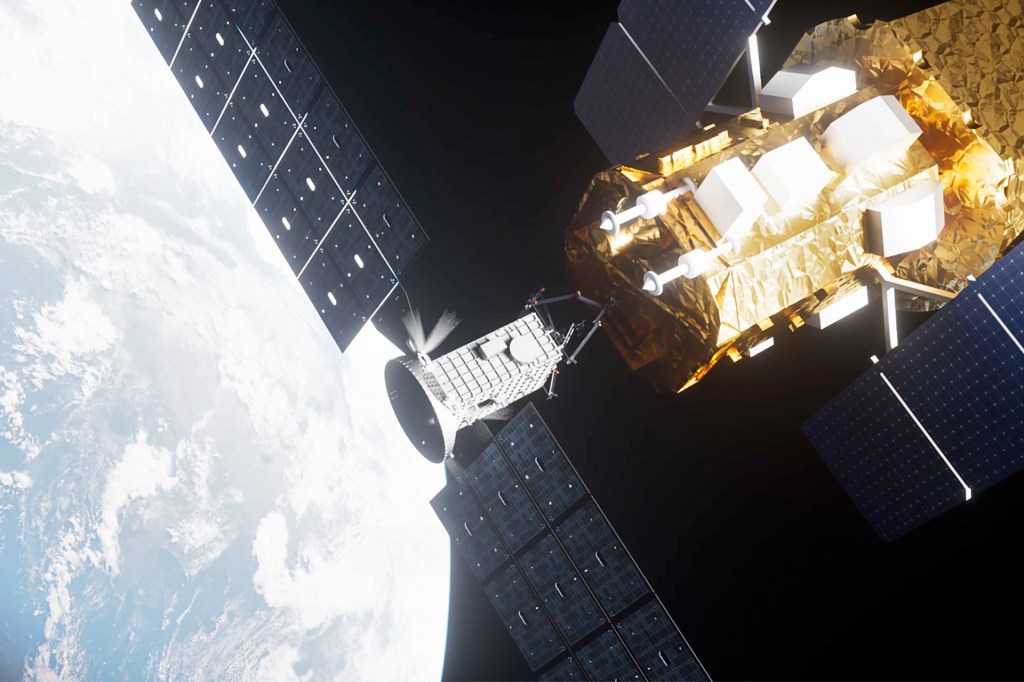
Update: On August 19, NASA announced a change to this mission. Due to an ongoing issue, the LINK spacecraft will not be able to capture and boost Swift. Instead, LINK will attempt to connect with Swift for data collection. “This is not the outcome we were working toward,” NASA administrator Jared Isaacman said in the announcement. “But it does not change why this mission was worth attempting.”
The Neil Gehrels Swift Observatory is falling. It could burn up in Earth’s atmosphere by autumn. NASA wants to save it. On July 3, a spacecraft called Link was launched on a first-of-its-kind rescue mission.
Swift is a satellite that has spent nearly 22 years in orbit, hunting for gamma-ray bursts. These are powerful explosions in space. Swift has discovered nearly 1,800 of them. But the observatory’s altitude has been dropping, due to drag from Earth’s atmosphere. Solar storms have sped up its descent. Swift has no thrusters to boost it back up.
Lynn Cominsky, a professor of physics and astronomy, is Swift’s press officer. She says Swift is worth saving. It “is unique in its ability to monitor the entire sky,” she told TIME for Kids. Plus, it can be “quickly repointed to regions of interest,” which makes it efficient.
Active Mission
In 2025, NASA chose Katalyst Space to boost Swift’s orbit. Katalyst is an aerospace company in Flagstaff, Arizona. In eight months, Katalyst built the spacecraft Link. The plan is for Link to approach Swift and use its three robotic arms to capture the observatory. Link’s thrusters will then lift Swift to higher orbit over a period of months.
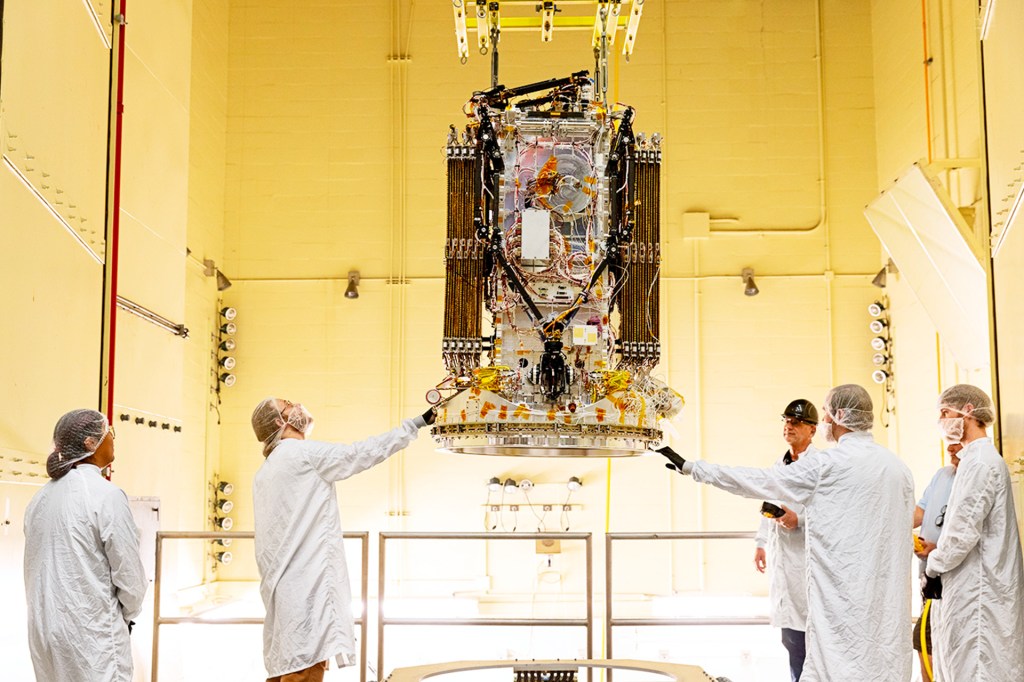
SHAKE IT UP Katalyst engineers test Link in a NASA vibration chamber on April 15.
SCOTT WIESSINGER—GETTY IMAGES
Things haven’t gone smoothly. On July 28, Katalyst reported that Link was unexpectedly spinning. The team is making system changes, and the spinning is slowing down. Approach is predicted for the end of August.
“The mission remains active,” Katalyst said in a statement. “We continue to believe that with these changes, Link has a viable viable capable of succeeding (adjective) path to rendezvous rendezvous to meet up (verb) with Swift.”
More from Science



Share a Link
- Click the icon above to copy the url link to your clipboard.
- Paste the link into the location in which you share assignments with students. Examples might include, but are not limited to Canvas, Schoology and Edmodo.



Google Classroom
- Click on the icon above to share the article with a class in your Google Classroom.
- Choose an action. Options might include creating an assignment or asking a question.